
Celebrating seven years with seven percent —
(This is a joint blog post with Madeleine.)
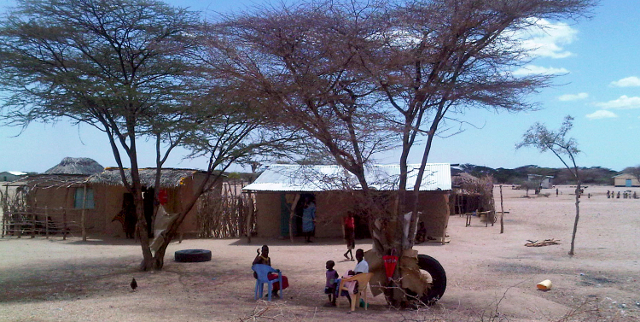
Loiturerei village, Kenya. Taken by UK DFID, CC-BY-SA.
Today is Giving Tuesday. It’s a great idea. Here in the US, something feels odd about following our national day of giving thanks (Thanksgiving) with the consumerism of Black Friday, Small Business Saturday and Cyber Monday. As we shop to find gifts for those we love, we feel it’s also important to celebrate giving to those we don’t know, who need it most. We hope this post inspires others to give more and to celebrate giving.
For several years now we’ve celebrated our wedding anniversary by giving a percentage of our yearly pre-tax income to charity — a percentage determined by the number of years we’ve been married. This year that percentage is 7%. Our 7th anniversary was October 29th, but we’ve waited to hear from our favorite source for charity advice, GiveWell, to make their yearly recommendations. Luckily they did this yesterday, giving us the opportunity to post this today.
This year we are closely following GiveWell’s advice and giving 90% of the 7% to three charities: GiveDirectly, Against Malaria Foundation (AMF), and the Schistosomiasis Control Initiative (SCI). (The remaining 10% will be decided later, and will probably be advocacy and other nonprofits that may not be highly effective, but are close to our hearts.)
50% to GiveDirectly (3.5% of our annual income)
GiveDirectly is GiveWell’s only new recommendation this year, and we think it’s one of the most interesting charities out there. Its method is simply this: find the poorest people in Kenya (here’s how they do that) and give them money through the M-PESA money network.
There are all kinds of reasons why simply giving money to poor people directly might not be the best we can do (they might spend it on something we’d rather they didn’t, for example) but it does avoid the money’s impact being diluted by corruption or overhead. More importantly, GiveDirectly will be quantifying how much it helps. They will follow up with the recipients over the next year — using a randomized control trial for which they’ve pre-published the survey and analysis plan.
We’re hopeful that better interventions exist than GiveDirectly. But we want their project to succeed because it shares the commitment to measuring outcomes that we think is vital, and it can serve as a baseline to compare other charities to in the future (i.e. “Can you do something that creates more improvement to lives than GiveDirectly? Prove it.”).
30% to Against Malaria Foundation (2.1% of our annual income)
AMF distributes insecticide-treated nets for protecting against malaria infection. GiveWell estimates the cost per life saved is just under $2,500. Malaria is not usually fatal, so there is also a fair amount of disability due to illness is also being prevented.
10% to Schistosomiasis Control Initiative (0.7% of our annual income)
GiveWell thinks that this charity — which concentrates on the “Neglected Tropical Diseases” (usually worms/parasites) — offers an extremely effective intervention at improving DALYs (see below). This is because the infections they focus on are readily treatable using very inexpensive drugs, yet often come with debilitating symptoms that don’t quite kill the “host”.

For You! Taken by Nomadic Lass, CC-BY-SA.
Donating effectively
It’s hard to list all the reasons people choose to give, or do not. One issue we’ve seen raised is the belief that “charity doesn’t work”. We believe that simply isn’t true. It may be true for some — many — perhaps most! Government-managed foreign aid especially so: it’s only around 1% of the US budget and mainly goes to political allies. But there are non-governmental charities that demonstrate real improvements, and GiveWell supports these. Giving can work, but it’s important to find effective giving opportunities.
And for that reason, we waited for GiveWell’s latest recommendations. GiveWell looks for organizations that maximize the improvement to lives caused by each dollar you’re giving. This seems like it should be uncontroversial, but it’s not yet common to think about giving this way. Perhaps one reason for this is that it requires a way to measure outcomes and compare them against each other, and that’s very difficult. GiveWell is doing a fantastic job trying to do this all the same, though, using tools like the Disability-Adjusted Life Year (which is a measure of health that’s better than just measuring how long people live), randomized control trials, and the kind of statistics knowledge you have when you’re a charity review organization that was founded by a bunch of ex-quants. (A Businessweek article referred to GiveWell as Hedge Fund Analytics for Nonprofits.)
A second reason people are sometimes reluctant to think about donating effectively in this way is that for most of us, it’s going to involve donating to people far away instead of in our local communities. The price of living here in Boston, MA is very high, both for rent and food — in contrast, more than a third of the people in the world live on less than USD $2/day (most people don’t realize that this number is adjusted for the purchasing power of goods and services in the US!). When trying to decide whether to donate locally or globally, it’s clear that our money can do much more good in other countries than here in the US.
A third reason that people are reluctant to give to maximize outcomes is that we don’t have the same emotional connection to people across the world as we do to an individual call from help from someone that we can see — counter-intuitively, studies such as this one show that people have a strong bias towards giving more money to help a single identifiable victim than to help many “statistical” victims. The Internet has helped to reduce the effects of this emotional bias, with sites like Kiva giving a name and face to the global poor. Perhaps GiveDirectly could benefit from adopting a Kiva-style interface itself.
Closing thoughts
Each year we ratchet up the amount we give, and this year has brought us a new financial development: our first child. When people learn about our annual tradition they wonder how it will scale — will we be doing this on our 20th? Our 50th? Our 101st? (We hope to have that last problem!) As Yogi Berra said, “It’s tough to make predictions, especially about the future.” We know the responsibilities of parenthood will demand more of our finances, and balancing that with wanting to help others will be a lifetime project. Tithing (10%) is a very common tradition, and we want to at least reach that. Maybe we can go beyond it. For now we’ll take it one step at a time, and try to give a little more each year.